Everyone knows video works.
The stats are everywhere: video increases engagement by 80%, boosts conversion rates by 85%, improves email click-through by 300%. Every marketing expert and their grandmother tells you that video is non-negotiable in 2025.
So businesses invest. They buy cameras, hire editors, create content calendars, and start publishing videos.
And then… nothing happens.
Their view counts are mediocre. Engagement is flat. Sales don’t budge. The videos exist, but they’re not moving the needle.
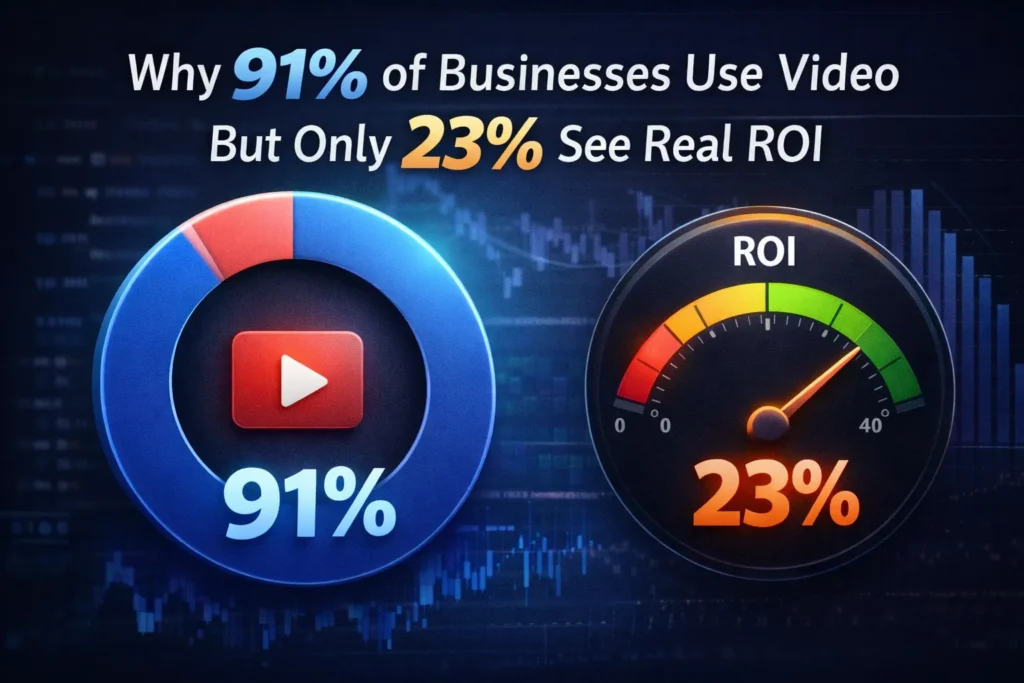
Here’s the uncomfortable truth: 91% of businesses use video marketing, but research shows that less than a quarter of them see meaningful ROI from it.
That’s not a video problem. That’s an execution problem.
Let me show you exactly why most businesses fail at video—and what the successful 23% are doing differently.
The Three Lies Killing Your Video ROI

Before we talk solutions, let’s address the myths that are probably sabotaging your video strategy right now.
Lie #1: “We Just Need to Make Videos”
Wrong. You need to make GOOD videos, CONSISTENTLY, that actually align with your business goals.
Most businesses approach video like this:
- Month 1: “Let’s try video!” (Creates 3 videos, posts enthusiastically)
- Month 2: “This is harder than we thought” (Posts 1 video)
- Month 3: “We’re too busy” (Posts nothing)
- Month 4: “Video doesn’t work for us” (Gives up)
Sporadic, low-quality content doesn’t work for anyone. The algorithm doesn’t reward inconsistency, and your audience won’t follow you if they don’t know when (or if) you’ll show up.
The successful 23% treat video like a system, not a campaign.
Lie #2: “More Views = More Success”
If your video gets 50,000 views but generates zero leads or sales, did it actually work?
Vanity metrics feel good but mean nothing if they don’t tie to business outcomes.
I’ve seen businesses celebrate viral videos that got 500K views and generated exactly zero dollars in revenue. Meanwhile, their competitor’s “boring” 2,000-view video about their service generated $50,000 in sales.
The successful 23% optimize for outcomes, not eyeballs.
Lie #3: “We Can Figure This Out In-House”
“My intern knows iMovie. We’ll just do it ourselves.”
Sure. And your nephew can probably build you a website in WordPress. How’d that work out?
Video editing is a skill that takes years to master. Professional editors understand pacing, storytelling, visual psychology, platform-specific optimization, and a dozen other nuances that make the difference between content that converts and content that flops.
The successful 23% respect the craft and work with professionals.
Why Most Video Strategies Fail: The Real Reasons
Let’s dig into what’s actually going wrong for the 77% who aren’t seeing ROI.
Problem #1: Inconsistent Publishing
The algorithm on every platform—YouTube, Instagram, TikTok, LinkedIn—rewards consistency.
Post daily? The algorithm shows your content to more people.
Post once a month? The algorithm assumes you’re not serious and barely shows your content at all.
But here’s the trap: creating consistent video content is HARD when you’re:
- Filming everything yourself
- Writing scripts between meetings
- Waiting 5-7 days for your freelance editor to deliver
- Spending hours giving feedback on edits
Most businesses start strong, then get overwhelmed by the production demands and fade into inconsistency. By month three, they’re posting sporadically. By month six, they’ve given up.
What the successful 23% do differently:
They build systems for consistency. They batch-film content, use dedicated editing teams, and treat video production like an assembly line—not an art project that requires inspiration to strike.
Problem #2: Quality Inconsistency
Nothing destroys trust faster than wildly inconsistent video quality.
When your audience sees:
- Monday: Professional video with great pacing, clean graphics, on-brand colors
- Thursday: Choppy edit with stock music that doesn’t fit, off-brand fonts, weird cuts
They subconsciously think: “This brand doesn’t have their act together.”
This happens when you’re juggling multiple freelance editors, doing some editing yourself, and having different team members approve the work without a clear brand standard.
What the successful 23% do differently:
They work with dedicated teams who learn their brand inside and out. Every video looks like it comes from the same professional source because it does.
Problem #3: Wrong Content for the Platform
A 15-minute YouTube deep-dive won’t work as an Instagram Reel.
A talking-head video optimized for LinkedIn will bomb on TikTok.
A highly-edited, trendy short won’t resonate on your email newsletter.
Different platforms have different audiences with different expectations. Yet most businesses create one video and try to use it everywhere—which means it’s optimized for nowhere.
What the successful 23% do differently:
They either create platform-specific content from the start, or they work with editors who can repurpose one piece of content into multiple platform-optimized versions.
Problem #4: No Clear Goal for Each Video
Ask most businesses: “What’s the goal of this video?”
The answer is usually: “Um… views? Engagement? Brand awareness?”
That’s not a goal. That’s a hope.
Every video should have ONE clear objective:
- Drive traffic to your website
- Generate leads through a specific CTA
- Educate your audience about a problem you solve
- Showcase a product feature
- Build authority by sharing insights
- Nurture existing customers
When you don’t know what you want the video to accomplish, it accomplishes nothing.
What the successful 23% do differently:
Every video has a specific goal, a clear CTA, and metrics to measure success. They don’t make videos for the sake of making videos.
Problem #5: The Production Bottleneck
You know what kills video ROI faster than anything?
Not publishing the video at all.
Most businesses have a graveyard of raw footage that never got edited. Brilliant ideas that never saw the light of day. Timely content that became irrelevant while waiting in the editing queue.
Why? Because their editing process is slow, expensive, or both.
- Your freelancer is booked with other clients for two weeks
- Your in-house editor is overwhelmed with requests
- You’re doing it yourself but keep pushing it to next week
Meanwhile, your competitors are publishing daily and capturing the audience you should’ve had.
What the successful 23% do differently:
They eliminate the editing bottleneck entirely. Fast turnarounds mean they can publish quickly, test rapidly, and iterate based on what works.
The ROI Formula That Actually Works
Here’s what the successful 23% understand that everyone else doesn’t:
Video ROI = (Quality × Consistency × Strategy) ÷ Production Friction
Let’s break that down:
Quality: Professional editing, good storytelling, clear audio and visuals. This builds trust and keeps people watching.
Consistency: Regular publishing schedule that trains your audience to expect and look forward to your content. This builds the algorithm and audience loyalty.
Strategy: Every video has a purpose tied to business goals, with appropriate CTAs and distribution plans. This ensures effort translates to results.
Production Friction: The time, cost, and hassle required to go from idea to published video. The higher the friction, the lower your ROI.
Most businesses focus exclusively on Quality while ignoring the denominator—Production Friction.
They obsess over getting each video “perfect” while publishing once a month and wondering why their competitor’s “good enough” daily videos are destroying them.
The successful 23% understand that:
Good videos published consistently beat perfect videos published rarely.
Case Study: Two Businesses, Same Budget, Opposite Results
Let me show you how this plays out in real life.
Company A (The 77%):
- Budget: $3,000/month for video
- Approach: Hire freelancer at $150/video, get 20 videos/month
- Reality: Inconsistent turnarounds, quality varies, no time for strategy
- Results: 50K total views/month, minimal engagement, zero trackable sales
Company B (The 23%):
- Budget: $2,000/month for video
- Approach: Unlimited editing subscription, 60+ videos/month
- Reality: Fast turnarounds, consistent quality, time to focus on strategy
- Results: 180K total views/month, high engagement, $47K in tracked revenue
Same industry, smaller budget, 10× better results.
The difference? Company B eliminated production friction, which allowed them to:
- Publish 3× more content (consistency)
- Test different formats rapidly (strategy)
- Maintain brand consistency (quality)
- Focus on optimization instead of project management (strategy)
What Holding You Back From the Successful 23%?
Let’s get brutally honest. Which of these sounds like you?
“We don’t have time to make more videos”
Translation: Your editing process is too slow and requires too much of your personal involvement. This is a systems problem, not a time problem.
“Video is expensive”
Translation: You’re paying per-video rates with a freelancer, which makes scaling expensive. Subscription models make volume affordable.
“Our videos don’t get views”
Translation: You’re not posting consistently enough for the algorithm to take you seriously, or your quality isn’t good enough to retain viewers.
“We tried video and it didn’t work”
Translation: You posted 10 videos over three months, got discouraged, and quit before building any momentum. That’s not “trying video”—that’s dabbling.
“We’re too busy to manage video production”
Translation: You’re stuck in project management hell with freelancers instead of using a system that handles production for you.
Every single one of these obstacles can be solved with the right approach.
The Path to Joining the Successful 23%
Here’s exactly what you need to do:
Step 1: Commit to Consistency Over Perfection
Decide on a publishing schedule you can actually maintain:
- 3 videos per week? Great.
- 1 video per day? Even better.
- 5 short-form videos daily? You’re playing to win.
Then protect that schedule like your business depends on it (because it does).
Step 2: Remove Production Friction
Your editing process should be fast, predictable, and require minimal involvement from you:
- Upload footage
- Provide clear brief
- Review edit
- Publish
If your current process has 15 steps and requires constant follow-up, you need a better system.
Step 3: Define Clear Goals for Your Content
Every video should answer:
- What’s the objective?
- Who’s the audience?
- What action do we want them to take?
- How will we measure success?
No more “let’s make a video about X” without strategic intent.
Step 4: Scale Smartly
Once you find a format that works, double down. Create systems to produce more of what’s working instead of constantly reinventing the wheel.
The successful 23% aren’t creating 47 different types of videos. They’re creating variations on 3-5 proven formats.
Step 5: Track What Matters
Stop obsessing over view counts. Start tracking:
- Click-through rates on your CTAs
- Lead generation from video content
- Sales attributed to video touchpoints
- Email signups from video landing pages
- Customer questions answered by video content
If video isn’t driving business outcomes, either your content or your measurement is broken.
The Uncomfortable Truth
You already know video works. You’ve seen the stats. You’ve watched your competitors grow using it.
The question isn’t whether video can generate ROI for your business.
The question is whether you’re willing to do what the successful 23% do:
- Commit to consistency
- Invest in quality
- Remove production friction
- Think strategically
- Measure what matters
If you’re not willing to do those things, video won’t work for you—not because video doesn’t work, but because half-measures never do.
But if you ARE willing to commit, the opportunity is massive. While 77% of businesses fumble their way through video marketing with inconsistent results, you can be the outlier who actually makes it work.
The successful 23% aren’t magic. They just have better systems.