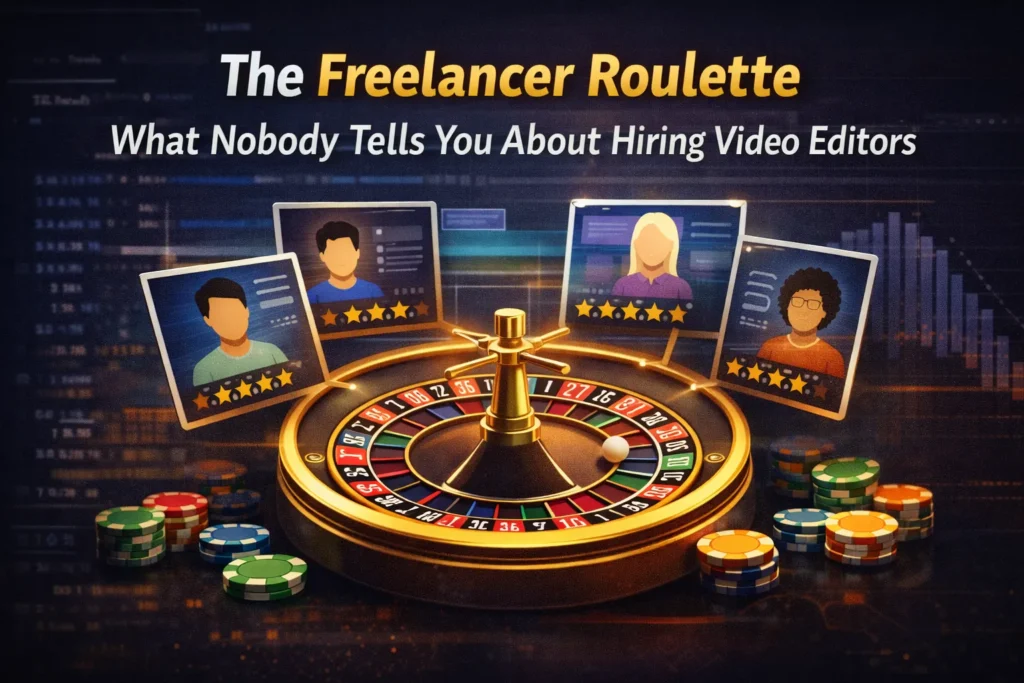
Hiring a freelance video editor feels a lot like gambling.
You browse portfolios that all look impressive. You read reviews that are mostly 5-stars. You hop on a call where they say all the right things. You send over your first project feeling optimistic.
Then you spin the wheel and hope for the best.
Sometimes you win—you get a talented, reliable editor who delivers exactly what you need, on time, at the quoted price.
But more often? You lose.
The editor ghosts you mid-project. The quality is nothing like their portfolio. They’re suddenly “too busy” when you need something urgently. The style that looked perfect for someone else’s brand doesn’t work for yours at all.
Welcome to Freelancer Roulette—the expensive, frustrating game that most businesses don’t realize they’re playing until they’ve already lost thousands of dollars and months of momentum.
Let me show you what nobody tells you before you hire your first video editor.
The Portfolios That Lie
Here’s the first thing you need to know: that stunning portfolio you’re admiring? It probably tells you nothing about what working with this editor will actually be like.
Why portfolios are misleading:
They show the editor’s best work from their entire career
That viral video they edited three years ago for a Fortune 500 brand? Great. But can they deliver that quality for your $500 project? Probably not.
Portfolio pieces are carefully curated highlight reels, not representative samples of typical output.
They don’t show you their worst work
Every editor has projects they’re not proud of. Maybe the client’s vision was terrible. Maybe they were learning a new technique. Maybe they were rushing to meet an impossible deadline.
You’ll never see those videos in their portfolio—but there’s a good chance your project might end up looking like them.
They don’t reflect current skill levels
That editor might’ve gotten worse. Or much better. Or specialized in a completely different style since creating those portfolio pieces.
The portfolio is a time capsule, not a current representation.
The style might be right for the wrong reasons
An editor might’ve achieved that aesthetic because:
- The client had a massive budget for motion graphics
- They spent 40 hours on a 2-minute video
- They collaborated with three other specialists
- The project was passion-work they did for exposure
When you hire them for a standard project with a standard budget and a tight deadline, you’re not going to get the portfolio version.
The “Available” Editor Who Disappears
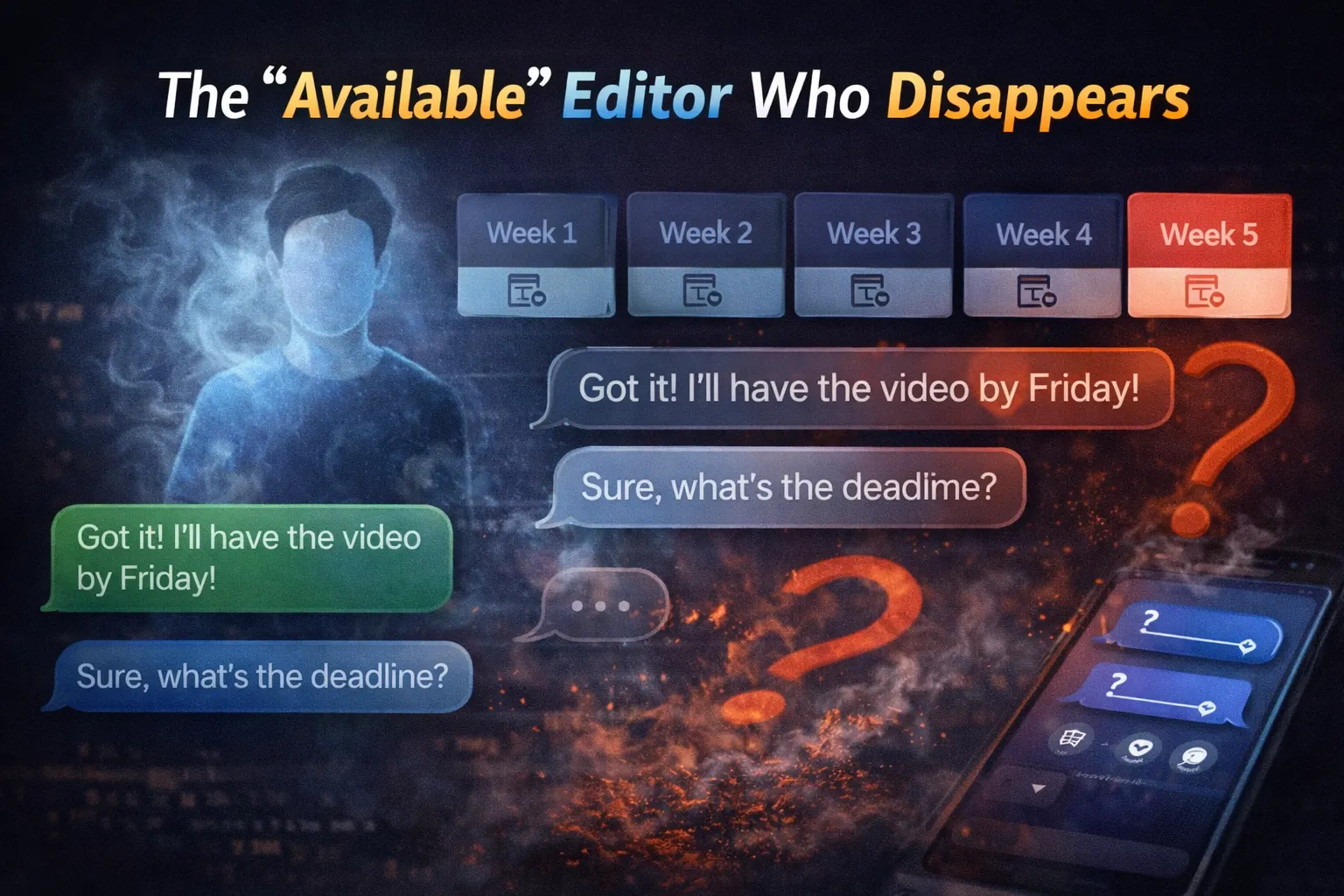
Let’s talk about the most common way Freelancer Roulette destroys businesses: the vanishing act.
The scenario plays out like this:
Week 1: You find an editor. They respond quickly to your inquiry. They’re enthusiastic about your project. They have availability starting next week. Perfect!
Week 2: You send the brief and footage. They confirm receipt and promise delivery by Friday. You’re feeling good.
Week 3: Friday comes and goes. No video. You follow up. They apologize—”family emergency” or “got slammed with another project” or “my computer crashed.” They promise to deliver Monday.
Week 4: Still nothing. Your messages are being read but not answered. You’re now posting on LinkedIn desperately asking if anyone knows a good video editor.
Week 5: They finally respond with the first draft. It’s… fine, but not what you asked for. Also, your deadline was two weeks ago.
I’ve talked to hundreds of business owners, and this story is depressingly common.
Why does it happen?
Freelancers have no obligation to prioritize you
When a bigger client or better opportunity comes along, you get bumped. Simple as that.
Their availability estimate was optimistic
They thought they’d have time, but they underestimated other projects or overestimated their capacity.
They took on more work than they can handle
Most freelancers are terrible at saying no. They say yes to everyone, then scramble to figure out how to actually deliver.
Life happens
Freelancers get sick. They have family emergencies. Their equipment breaks. They’re human—but when you’re running a business that depends on consistent content, “human” isn’t enough.
The Quality Lottery
Even when editors DO deliver on time, there’s still the question of quality—and this is where Freelancer Roulette gets really expensive.
You won’t know what you’re getting until you get it.
Scenario A: The “Close Enough” Editor
They technically delivered what you asked for. The video has all the right elements. But something’s… off.
- The pacing feels weird
- The music doesn’t quite match the vibe
- The transitions are jarring
- It just doesn’t feel right
You can’t quite articulate what’s wrong, but you know it’s not what you envisioned. Now you’re stuck choosing between accepting mediocrity or spending hours writing detailed feedback hoping the editor can fix it.
Scenario B: The “That’s Not What I Asked For” Editor
You requested a fast-paced, energetic video with bold graphics and trendy music.
They delivered a slow, dramatic video with minimal text and ambient sounds.
Did they not read the brief? Did they think they knew better? Are they just bad at interpreting direction?
Doesn’t matter—you now have to start over or settle for something that won’t work for your audience.
Scenario C: The “Technical Disaster” Editor
The audio is out of sync. The resolution is wrong for the platform. The export settings are messed up. There are rendering artifacts throughout.
They’re obviously inexperienced, but their portfolio looked great. (See the earlier section on why portfolios lie.)
Scenario D: The “Over-Delivers on the Wrong Things” Editor
You needed a simple, clean edit delivered fast.
They spent hours adding complex animations, custom graphics, and intricate effects you didn’t ask for and don’t need.
The video looks amazing, but it took 3× longer than necessary and the style doesn’t match your brand.
Here’s the brutal truth: You won’t know which scenario you’re getting until you’ve already paid the deposit and sent your footage.
The Hidden Costs of Freelancer Roulette
Let’s talk about what this game actually costs you.
Cost #1: The Onboarding Tax
Every new editor requires:
- Explaining your brand voice and visual identity
- Sharing style references and examples
- Describing your audience and goals
- Teaching them your preferences and pet peeves
This takes time—usually 2-4 hours per editor—and has to be repeated every time you switch editors.
If you go through 4 editors in a year (very common), that’s 8-16 hours of your time just on onboarding.
Cost #2: The Revision Spiral
Most freelancers include 1-2 revision rounds. After that, you’re paying extra.
But here’s what happens: they didn’t understand your vision on round 1. They got closer on round 2. Round 3 is the one where it finally clicks—but that’s $100-200 in extra fees you weren’t planning for.
Multiply that across dozens of videos and you’re spending thousands on revisions that should’ve been included in the base price.
Cost #3: The Emergency Replacement
Your regular editor went MIA and you need a video finished by tomorrow.
You find someone who can do rush delivery for 2-3× the normal rate. You have no choice—the deadline is real—so you pay it.
This happens more often than you’d think. One business owner I talked to spent $4,000 in a single month on emergency rush editing because their regular freelancer kept flaking.
Cost #4: The Opportunity Cost
Every week without content is a week your competitors are gaining on you.
Every video delayed is momentum lost.
Every project stuck in revision hell is time you’re not spending on growing your business.
The opportunity cost of Freelancer Roulette is impossible to calculate precisely, but it’s almost certainly the biggest expense of all.
The False Solutions That Don’t Work
By now you’re probably thinking: “Okay, I get it. Freelancers are risky. What do I do instead?”
Let me save you some time by telling you what DOESN’T work:
“I’ll just hire multiple editors as backup”
Now you’re managing multiple freelancers, explaining your brand to multiple people, and dealing with even more inconsistency as different editors interpret your vision differently.
This doesn’t solve the problem—it multiplies it.
“I’ll hire someone full-time”
If you have enough volume (100+ videos per month), maybe. But most businesses don’t.
You’ll pay $50,000-75,000 annually for an in-house editor who’s either:
- Sitting idle half the time (wasting money)
- Overwhelmed with requests (creating bottlenecks)
- Eventually burning out and quitting (back to square one)
Plus benefits, equipment, software licenses, office space… the costs add up fast.
“I’ll learn to do it myself”
You’re a CEO, marketer, coach, creator, or business owner. Your time is worth $100-300+ per hour.
Spending 4-5 hours editing a video yourself makes no financial sense, and the quality will never match a professional.
This is like a surgeon deciding to do their own accounting. Could they learn? Sure. Should they? Absolutely not.
“I’ll use AI editing tools”
AI tools are getting better, but they’re still nowhere near human editors for:
- Understanding nuance and storytelling
- Making creative decisions that serve your goals
- Adapting to your brand’s unique voice
- Handling complex projects with multiple elements
AI can help, but it can’t replace a skilled editor. Not yet anyway.
What Actually Works: Getting Off the Roulette Wheel
The businesses that have solved Freelancer Roulette didn’t do it by finding “the perfect freelancer.” They did it by changing the game entirely.
Here’s what works:
Solution: Dedicated Teams Over Individual Freelancers
Instead of hiring one person who might ghost you, you work with a team where:
- If one editor is unavailable, another steps in seamlessly
- Your brand knowledge is documented and shared across the team
- Quality is consistent because they have internal standards and review processes
- There’s always someone available when you need something urgently
Solution: Subscription Models Over Per-Project Pricing
Instead of paying per video (which incentivizes editors to maximize hours), you pay a flat monthly fee for unlimited editing.
This completely changes the dynamic:
- No surprise costs for revisions or rush requests
- No “should I edit this or not?” calculations
- No project management overhead
- Predictable budgeting
Solution: Specialized Platforms Over Email Coordination
Instead of juggling Dropbox, email, text messages, and phone calls, you work through a single platform built specifically for video production:
- Upload footage in one place
- Brief editors with structured forms
- Review and approve with timestamped feedback
- Download finished videos in all needed formats
No more “Did you get my email?” or “Which version did we approve?”
Solution: Long-Term Partnerships Over Transactional Relationships
Instead of starting from scratch with each project, you build an ongoing relationship where:
- Editors learn your style and preferences over time
- Quality improves because they understand your brand deeply
- Turnaround speeds increase because they know what you want
- You can focus on strategy instead of managing production
The Risk-Free Way to Get Off the Roulette Wheel
Here’s what I recommend if you’re tired of gambling on freelancers:
Try a subscription-based video editing service for 14 days.
Most reputable services offer risk-free trials where you can:
- Submit real projects and see the quality
- Experience the turnaround times
- Test the platform and communication
- Evaluate if it solves your problems
If it doesn’t work, you’re out nothing. If it does work, you’ve permanently solved your Freelancer Roulette problem.
The businesses I’ve seen make this switch typically report:
- 60-80% cost savings (when factoring in all hidden costs)
- 3-5× faster turnarounds
- 10× less stress and project management time
- Dramatically more consistent quality
Stop Gambling With Your Content Strategy
Freelancer Roulette is expensive, frustrating, and completely unnecessary.
You don’t need to:
- Hope your editor doesn’t ghost you
- Wonder if the quality will be good this time
- Pay surprise fees for extra revisions
- Waste hours managing and onboarding editors
- Cross your fingers that deadlines will be met
You need a system that works every single time—predictably, affordably, and professionally.
The successful businesses you’re competing with figured this out years ago. They stopped gambling and started building reliable systems for video production.
The question is: how much more time and money are you willing to lose before you do the same?