The freelance video editing market is full of lies.
Not malicious lies – just convenient exaggerations that help people charge more than they’re worth.
“10 years of experience” means they made a few birthday videos in 2015 and then didn’t touch an editing program again until last year.
“Senior Editor” means they changed their LinkedIn title after completing a YouTube tutorial series.
“Expert in All Platforms” means they know how to export in different aspect ratios.
I’m not saying all freelance editors are frauds. I’m saying the market has a massive title inflation problem, and you’re paying premium rates for junior-level work.
Let me show you exactly what’s happening – and how to stop getting ripped off.
The “Senior” Editor Who Isn’t

Here’s how title inflation actually works in the freelance video editing world:
Year 1: “Aspiring video editor. Learning Premiere Pro. Will edit for exposure!”
Year 2: “Video Editor. Proficient in Adobe Premiere and basic motion graphics.”
Year 3: “Experienced Video Editor. Specialized in social media content and corporate videos.”
Year 4: “Senior Video Editor. 10+ years of production experience (counting the time I filmed skateboarding videos on my phone in high school).”
Notice how “10+ years” suddenly appears when they’ve been doing professional paid work for maybe three years?
Here’s the uncomfortable truth: in the freelance market, you become “senior” whenever you decide you want to charge senior rates.
There’s no certification. No review board. No minimum experience requirement.
If you can put together a decent portfolio (even if it’s mostly YouTube tutorials and spec work), update your title on Upwork, and charge $150/hour, congrats – you’re now a “Senior Video Editor.”
How to Spot Fake Experience (Red Flags You’re Missing)
When you’re evaluating editors, look for these warning signs that their “experience” is inflated:
Red Flag #1: The Padded Resume
“15 years of experience in video production”
Okay, let’s dig deeper. What were you doing 15 years ago?
“Well, I filmed my high school plays, and then in college I did some event videography…”
That’s not 15 years of professional video editing experience. That’s 2-3 years of actual paid work and 12 years of hobbies.
Real question to ask: “Tell me about the last 10 client projects you edited. What were the budgets, timelines, and deliverables?”
If they can’t give you specifics, they’re padding.
Red Flag #2: The Generic Portfolio
Their portfolio has:
- One wedding video
- One corporate “about us” video
- Three spec pieces they made to practice
- Two projects from the same client (probably their friend)
This isn’t a professional portfolio. This is a beginner’s showreel dressed up with good marketing copy.
Real question to ask: “Which brands or businesses have you worked with consistently over the past year?”
If the answer is vague or they dodge, they’re not actually working with clients regularly.
Red Flag #3: “Expert in Everything”
Their profile lists 47 skills:
- Adobe Premiere Pro ✓
- Final Cut Pro ✓
- DaVinci Resolve ✓
- After Effects ✓
- Motion Graphics ✓
- Color Grading ✓
- Sound Design ✓
- 3D Animation ✓
- (and 39 more…)
Nobody is expert-level at everything. Specialists focus. Beginners claim to do it all because they can’t actually do anything well enough to specialize.
Real question to ask: “What’s your primary specialization, and can you show me 10 recent examples of that specific work?”
Red Flag #4: The Borrowed Portfolio
Their portfolio looks suspiciously professional. The work quality is inconsistent – some pieces are incredible, others are mediocre.
Here’s a dirty secret: some editors showcase projects they barely touched. They:
- Worked on one small part of a major production
- Were assistant editor while someone else made creative decisions
- Did basic cuts while a senior editor handled finishing
- Bought portfolio templates and customized them slightly
Real question to ask: “Walk me through your exact role in this project. What creative decisions did you make?”
If they can’t explain specifics, they probably didn’t do the work they’re showing you.
Red Flag #5: The Rate That Doesn’t Match the Work
They charge $150/hour but:
- Respond slowly (real professionals value time)
- Ask basic questions about deliverables (experienced editors know the drill)
- Need extensive hand-holding (seniors should guide YOU)
- Deliver work with amateur mistakes (wrong aspect ratios, audio issues, sloppy cuts)
If the quality doesn’t match the rate, you’re being overcharged.
The Real Cost of Hiring Inflated “Seniors”
Let’s talk about what this actually costs you:
You’re Paying 2-3× What the Work Is Worth
A genuinely senior editor with 10+ years of experience editing high-profile commercial work? $150-200/hour is reasonable.
Someone who’s been doing freelance YouTube edits for 18 months? They should be charging $40-60/hour max.
But because you can’t easily verify experience, you end up paying senior rates for junior work.
Over a year, if you’re spending $3,000/month on editing, you could be overpaying by $1,500-2,000 monthly – that’s $18,000-24,000 annually.
You’re Getting Slower Turnarounds
Junior editors take longer to do everything:
- They need to Google techniques mid-project
- They don’t know keyboard shortcuts and efficient workflows
- They second-guess creative decisions instead of moving confidently
- They make more mistakes that require fixing
A senior editor might deliver a 10-minute video in 4 hours. A junior editor posing as senior might take 8-10 hours – and you’re paying for those extra hours.
You’re Getting Lower Quality Output
Experience matters in video editing:
- Pacing and rhythm: seniors feel it intuitively, juniors guess
- Story structure: seniors understand narrative flow, juniors follow formulas
- Problem-solving: seniors improvise solutions, juniors give up or ask for help
- Creative decisions: seniors elevate your content, juniors execute what you tell them
When you hire a fake senior, you get junior quality at senior prices.
You’re Stuck Doing More Project Management
Real senior editors need minimal direction. You say: “Make this energetic and engaging for Instagram, keep it under 60 seconds, emphasize the CTA at the end.”
They deliver exactly what you wanted.
Fake senior editors need constant guidance:
- “What music should I use?”
- “How fast should the cuts be?”
- “Should I add text here?”
- “What style of graphics?”
You end up doing the creative direction work yourself – while paying someone else to execute it slowly.
Why This Problem Keeps Getting Worse
Title inflation in freelance editing is accelerating, and here’s why:
Reason #1: There’s No Barrier to Entry
Anyone can:
- Download Premiere Pro (or use a cracked version)
- Watch YouTube tutorials for a few weeks
- Create a portfolio with spec work
- List themselves as “Senior Video Editor” on Upwork or Fiverr
There’s no licensing, no certification, no way to verify claims. The market is full of people who learned editing last year calling themselves experts.
Reason #2: Clients Can’t Tell the Difference
Most business owners aren’t video experts. They:
- Can’t evaluate technical quality
- Don’t know what good pacing looks like
- Can’t spot amateur mistakes
- Trust whatever the editor’s profile says
This creates a market where perception matters more than skill.
Reason #3: Race to the Top (in Pricing)
Freelancers quickly learn: if you charge $50/hour, clients assume you’re junior. If you charge $150/hour, they assume you’re senior.
So everyone inflates their rates – and their titles – to compete. The actual quality of work doesn’t change, but the prices do.
Reason #4: The Gig Economy Rewards Marketing Over Skill
On platforms like Upwork, success is determined by:
- How well you write your profile
- How quickly you respond to inquiries
- How many fake reviews you can generate
- How good your (possibly borrowed) portfolio looks
Actual editing skill? That’s secondary.
What To Do Instead: Three Better Approaches
Let’s talk about how to actually get value for your money:
Option 1: Test Before You Commit
Never hire an editor based solely on portfolio and profile. Always do a paid test project:
- Give them a real piece of footage
- Set a deadline (this tests reliability)
- Pay them fairly for the test (this shows you’re serious)
- Evaluate the result honestly
If the test project is mediocre, you’ve spent $200 learning they’re not worth $150/hour. That’s cheap compared to paying them for months of bad work.
Option 2: Focus on Recent, Verifiable Work
Ask for:
- Client testimonials with contact info you can verify
- Links to their work on actual brand channels (not just portfolio pieces)
- References from recent clients (within the past 6 months)
Anyone can create a portfolio. Not everyone can produce happy clients who’ll vouch for them.
Option 3: Use a Service With Built-In Quality Control
This is the approach that eliminates the guessing game entirely:
Work with an agency or subscription service that:
- Vets their editors’ actual skills before hiring them
- Has internal quality control processes
- Stakes their reputation on consistent quality
- Assigns teams (not individuals) so you’re not gambling on one person
When you work with beCreatives or similar services, you’re not hiring “John the Senior Editor who might be lying.” You’re hiring a team with proven processes, verified quality, and accountability.
You skip the entire title inflation problem because:
- They’ve already vetted the talent
- They guarantee the quality level
- If someone doesn’t meet standards, they’re replaced immediately
- You’re protected by the service’s reputation and policies
Stop Gambling, Start Getting Results
Here’s what I want you to take away from this:
Title inflation is costing you thousands of dollars every month.
Every time you pay $150/hour for work that should cost $50/hour, you’re being robbed.
Every time you trust a “10 years of experience” claim without verification, you’re gambling with your budget.
Every time you settle for mediocre work because you’ve already paid the deposit, you’re training yourself to accept less than you deserve.
There’s a better way.
Either:
- Invest the time to properly vet freelancers (test projects, reference checks, verified portfolios)
- Switch to a model where quality is guaranteed and title inflation doesn’t matter
Most businesses find option 2 is faster, cheaper, and dramatically less stressful.
The Math That Should Convince You
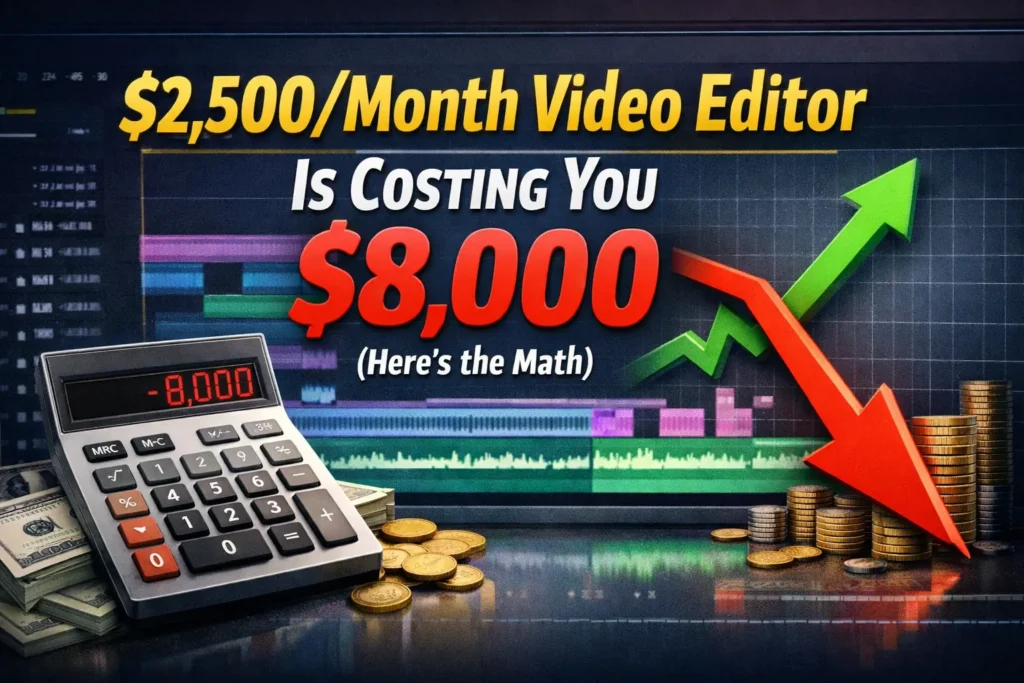
Let’s say you’re currently paying $2,500/month for a “senior editor” at $150/hour who’s really worth $60/hour:
Current setup:
- Paying: $2,500/month
- Getting: ~16 hours of junior-level work
- Real value: ~$960
You’re overpaying by $1,540 every single month.
Subscription service alternative:
- Paying: $1,999/month (for unlimited editing)
- Getting: As much editing as you need from a vetted team
- Real value: Easily $5,000-8,000 if you were paying per-project rates
You save $500+ monthly while getting better quality and more volume.
Over a year, that’s $6,000+ in savings – plus all the time you’re not spending on vetting, managing, and replacing fraudulent “senior” editors.
The Questions You Should Be Asking

Next time you’re considering hiring a video editor, ask:
- “Can I speak with three clients you worked with in the past 60 days?”
- “Show me 10 recent projects and explain your exact role in each.”
- “What’s your actual professional editing experience (paid client work only)?”
- “Can I see the full edit timeline or project file from one of your portfolio pieces?”
- “Will you do a paid test project before we commit to ongoing work?”
If they can’t or won’t answer these questions confidently, you’re about to hire another inflated “senior” who learned Premiere last year.
Or you can skip the interrogation entirely and work with a service that’s already done the vetting for you.